
Key Takeaways
- AI is changing how video teams research, brainstorm, organize, edit, translate, caption, and adapt content.
- Its most immediate value is often speed: less time spent on repetitive production work and more time available for creative decisions.
- Brand voice, emotional judgment, visual taste, and audience understanding still require human direction.
- Organizations need clear standards for reviewing AI-generated information, imagery, voices, likenesses, and other assets.
- The strongest production models will combine experienced creative people with carefully chosen AI tools.
Every few months, another AI tool arrives with a familiar promise. Write the script. Generate the voice. Build the image. edit the clip. Create the whole video.
Press a button and, apparently, the production team disappears.
Except that is not what is actually happening.
AI is changing video production, and in some areas the change is substantial. Tasks that once consumed hours can now happen in minutes. Transcripts appear almost instantly. Editors can search large amounts of footage faster. Writers can explore several structures before committing to one. Teams can create captions, resize versions, organize assets, clean audio, and produce rough translations with far less manual effort.
That is a real shift. It would be a mistake to minimize it.
But faster production is not the same thing as automatic creativity. The tools can accelerate a process; they do not remove the need to decide what the work should feel like, what the audience needs, what belongs to the brand, and what is simply not good enough to publish.
At Storyboard Studios, we think the most useful way to understand AI is as an expanding production toolkit. Used thoughtfully, it can remove friction from the work. Used carelessly, it can also make a lot of mediocre content very quickly.
Ai Is Very Good At The Boring Parts
Every creative job contains a surprising amount of work that is not particularly creative.
Interviews need to be transcribed. Footage needs to be logged and sorted. Captions have to be generated and checked. Large libraries need to be searched. Multiple aspect ratios have to be formatted. Audio may need cleanup. A long conversation might need to be summarized before anyone can even begin shaping the story.
These are exactly the kinds of tasks where AI can be genuinely useful.
When technology removes repetitive production work, the benefit is not simply that a team can produce more. The more interesting benefit is that skilled people can spend more of their time on the parts audiences actually notice: the opening, the story, the visual choices, the pacing, the emotional turn, the sentence that finally sounds right.
That is a better future for AI in creative work. Not fewer ideas. More time to make better ones.
Faster First Drafts Change The Process
The blank page has always taken time, whether the page belongs to a writer, an editor, or a creative director trying to find the first visual idea.
AI can make that page a little less blank.
A team might use it to organize research, compare possible script structures, generate a rough list of interview themes, summarize background material, or explore ten opening directions in the time it once took to develop two. An editor may use automated tools to locate every moment in an interview where a particular topic was discussed. A producer might turn a meeting transcript into a first-pass production brief.
The important phrase is first pass.
AI output becomes much less useful when the first answer is treated as the final answer. Strong creative work depends on making decisions that are specific to this audience, this company, this moment, and this message. Those decisions often involve subtleties that do not emerge from a generic request for “a professional corporate video.”
Professional is not a personality. Brands have personalities.
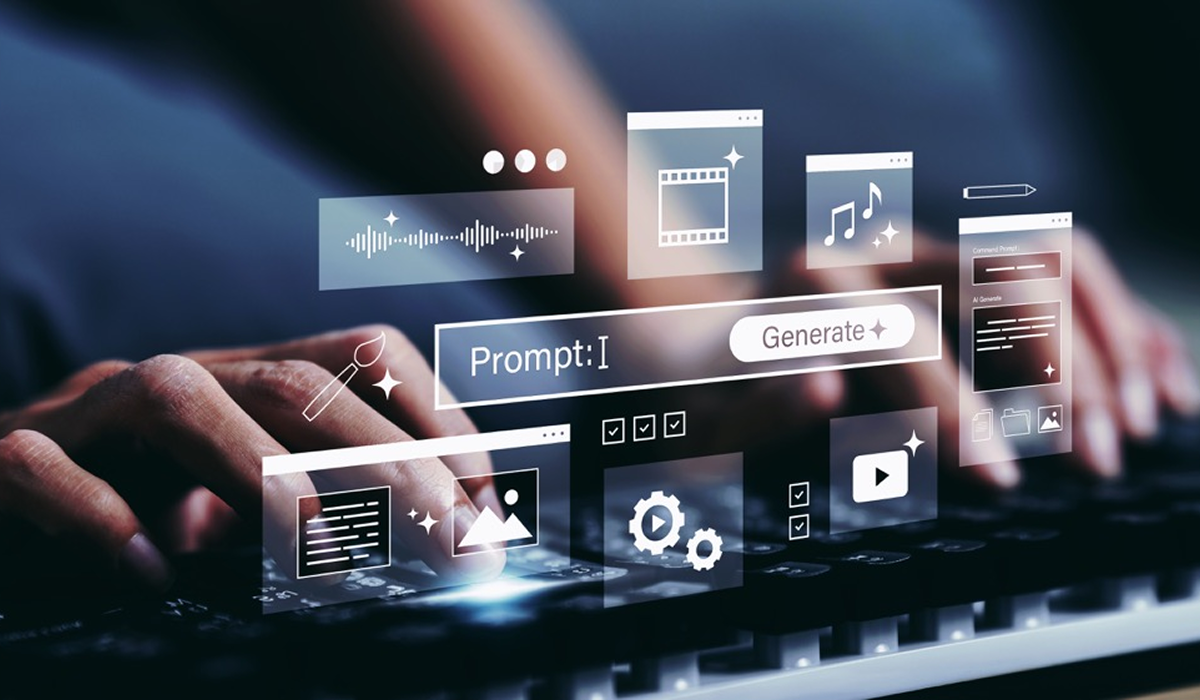
Generic Content Is The Real Risk
AI makes average content easier to produce, which is both its strength and its danger.
If thousands of organizations use similar prompts, similar synthetic voices, similar image generators, and similar editing templates, the result can be an enormous volume of technically competent material that feels strangely interchangeable.
Audiences may not consciously identify the problem. They may never say, “This video lacks specific creative judgment.” They simply stop watching.
Human direction is what turns broad possibilities into specific choices. Maybe the opening should be quiet instead of dramatic. Maybe the obvious stock image is precisely the wrong image. Maybe the CEO’s slightly imperfect sentence should stay because it sounds like something that person would genuinely say. Maybe the animation should pause for a beat instead of filling every second with motion.
These decisions can look small from the outside. In practice, they are where personality lives.
Human Judgment Matters Most At The Important Moments
An AI system can suggest ten visual ideas. Someone still has to know which one belongs to the brand.
It can produce five versions of a script. Someone has to hear which one sounds natural and which one sounds like polished filler. It can generate an image in seconds. Someone needs to decide whether that image is accurate, believable, appropriate, properly cleared for use, and consistent with what the company actually does.
Creative work is full of situations where “technically correct” and “actually good” are very different standards.
Experienced people live in that gap.
They understand that a perfectly grammatical line can still sound wrong in a CEO’s mouth. They know that a beautiful visual can undermine credibility if it misrepresents the product. They can sense when an edit is moving too quickly for the idea, or when a polished testimonial has been polished so heavily that it no longer feels trustworthy.
AI can generate options. Taste is what selects among them.
Ai Also Creates New Responsibilities
The conversation cannot only be about speed.
Organizations using generative tools also need to think seriously about provenance, accuracy, privacy, licensing, consent, and brand risk. Where did an image come from? Has a synthetic voice been approved? Is a generated statistic actually true? Does a translated sentence preserve the intended meaning? Is confidential information being placed into a tool that should not receive it?
If an AI-generated claim is wrong, customers will not care that software wrote it. The company publishing the video owns the mistake.
The same is true of synthetic imagery or voices. If a generated product image depicts something the product cannot do, the fact that it was created in seconds does not make the misrepresentation less real. If a cloned voice is used without clear permission, efficiency is not much of a defence.
As production gets faster, review standards become more important, not less.
AI may accelerate production. It should not accelerate errors.
What The Video Team Of The Future Looks Like
The creative team is not disappearing. Its job is shifting.
Less time may be spent on repetitive execution. More time can go toward concept development, storytelling, brand consistency, creative judgment, and deciding what deserves to be made in the first place.
Editors can search and assemble faster. Writers can explore more directions. Animators can test ideas earlier. Creative directors can compare more possibilities before committing the budget to one.
That can be a very good thing.
Creative industries have absorbed major technological changes before. Cameras changed. Editing moved from physical film to digital systems. Cloud collaboration transformed review cycles. Remote production changed who could participate and from where.
The tools moved each time. The need for taste did not.

A Scenario Worth Picturing
Consider an internal communications team that has finished a ten-minute leadership video and suddenly needs versions in six languages for a global town hall the following week. Not long ago, a timeline like that could have been extremely difficult. Professional translation, captioning, dubbing, review, and revision across six languages can consume weeks.
AI changes the first part of the equation. The team can generate rough transcripts, translations, and caption files quickly, perhaps within a day. That does not mean the work is finished. It means the human reviewers get more time.
A native-speaking reviewer in each region can check tone, terminology, and workplace-specific phrasing. They can catch the sentence that is technically translated correctly but culturally awkward. They can flag a term that means something different in the local market. The production team can focus on whether the final versions actually feel like the same message.
The AI did not replace those reviewers. It gave them breathing room to do their job properly.
That distinction is important.
Common Mistakes To Avoid
The biggest mistake is treating AI output as finished creative work instead of raw material. Another is adopting a tool simply because it exists. A generated visual that saves ten minutes but makes the brand look generic is not necessarily an improvement.
Organizations should also resist the urge to frame AI adoption primarily as a headcount exercise. A better starting question is operational: where does the team repeatedly lose time?
Research? Transcription? Versioning? Captions? Asset organization? Rough cuts? First drafts? Localization?
Those are sensible places to experiment because the value is measurable and the creative risk is relatively contained.
Give the technology the repetitive work first. Keep people focused on the decisions audiences will actually notice.
The most effective video teams will not be the ones that refuse AI, and they will not be the ones that hand the entire creative process over to it. They will be the teams that learn exactly where the tools make them faster without surrendering the judgment that makes the work worth watching.